This article was first published in British Dairying in March 2026.
Farm Assurance Assessor Jim Franklin explains how he carries out Red Tractor assessments and supports farmers in the process.
Having spent 30 years milking a herd of 150 Holstein Friesian cows, calving all year round, there’s no place I’d rather be than out on the farm, working with farmers. After leaving dairy farming, I was unsure what to do next, but my role as a Red Tractor assessor has allowed me to stay connected and support farmers in the sector. It’s opened my eyes to the different systems and innovative practices being used across the agricultural industry.
I typically visit one site a day to give farmers a good amount of time, and to ensure I don’t rush the process. This also means that every day offers something different, which I thoroughly enjoy. I travel the Scottish Borders, across Wales, down to Oxford and to Somerset, meeting farmers from dairy, beef, lamb, and arable sectors. They’re all working hard to produce high-quality British food in their own way – because of who they are, where they are and what they’re trying to achieve on their farm.
My preparation starts well before I set foot on a farm. About three weeks before each assessment, I will ring the farm to confirm the booking and details. During this call, I also check if they’re using the Red Tractor portal, which offers a great way to help prepare for an assessment. It’s not a requirement, but if they’re using the portal, I check they’re aware of its features and ask farmers to make sure their documents are uploaded 48 hours in advance of my visit to their farm.
It’s important to establish a positive relationship with farmers
This ensures I have time to review everything before I arrive. On the day of the assessment, I make sure I have the farm details ready, and all the essentials packed – a fully charged laptop, checklist, the Red Tractor standards, pen and paper, a clean pair of wellies and waterproofs.
When I arrive on the farm, the first step is to introduce myself to the farmer and explain exactly what I’m there to carry out, and the order for the next two to three hours. It’s important to establish a positive relationship with the farmers I assess.
I know they take pride in what they do, so I listen and reassure them that my role isn’t to catch anyone out. My job is to record the high standards they’re working to through consistent protocols, and a fair and open dialogue.
Understanding requirements
I am there to learn about how they farm, to share knowledge, and to aid their understanding of what the requirements of the standards are, which, when delivered with politeness, honesty, and a willingness to listen, is received positively. By the time I’m suited up, I have a good idea of how the farm is run and its layout, and the farmer knows what I’m there to look for.
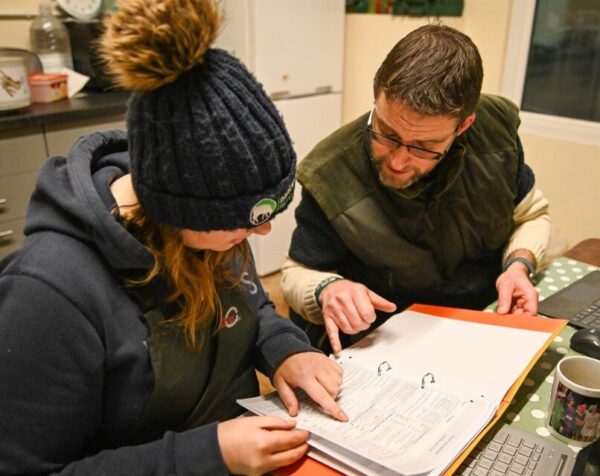
I then start the walk around the farm, generally going from clean to dirty, beginning in the parlour, then moving to the cows, medicine cabinets, calf rearing, and so on. Next, we undertake a couple of audit trails – usually over a cup of tea – which involve reviewing the necessary paperwork and documentation used to capture objective evidence within the requirements of the standard.
During this closing meeting, I provide a summary of what we’ve seen and any non-conformances that need addressing. This is the time to answer any final questions and try to support the farmer as much as possible.
Even with my background in dairy farming, as a self-employed farm assurance assessor, I know that I need to keep learning to stay current. I’m regularly assessed to ensure that my knowledge is up-to-date.
Every five years I undergo animal welfare training with AssureWel and partake in annual mobility scoring exams with the Register of Mobility Scorers (RoMS). In addition, I have a witnessed assessment every two years, where a senior assessor accompanies me on farm to observe my work.
I also use the Red Tractor Online Academy and participate in webinars to make sure I’m aware of any changes in standards and protocols across the dairy, beef, lamb and crop sectors. My experience as a dairy farmer has proved to be one of the biggest assets in my role, particularly as one of the main misconceptions about assessors is that they don’t have the agricultural knowledge and experience.
Empathy with farmers
On top of my knowledge, 30 years in farming has allowed me to emphasise with the farmers I meet. I know what it’s like to feel nervous about an assessment, and to be on the other side of the table, having been through the same process myself. But I believe this experience makes me better at what I do.
On most occasions, I know the mindset I’m walking into, and the challenges farmers are facing, meaning I can approach each assessment with an understanding that every farm is unique. I’m proud to still be part of the industry I’ve always cared about, and if I can help farmers feel supported, confident and recognised for the standards they work hard to achieve, then I know I’m doing my job well.